Last checked 19 August 2026
By 2028 the UK will require quarterly tax reporting from half a million businesses it cannot count
Making Tax Digital for Income Tax reaches turnover of £20,000 on 6 April 2028. A business does not appear on the national business register until it crosses £90,000. That leaves £70,000 of turnover in which a business must file with HMRC four times a year while remaining absent from the register that counts it. Our earlier analysis put around 500,000 construction businesses in exactly that position.
SoloDesks is not Making Tax Digital software. We do not appear on HMRC’s list of compatible software, we file nothing to HMRC, and nothing here is tax advice. This page is analysis of what a published policy does to a business of one. If you need to know your own position, the two HMRC guidance pages linked at the bottom are the primary source, and an accountant is the person to ask.
Contents
Key findings
- £20,000
- of turnover is where quarterly digital filing reaches, from 6 April 2028. Qualifying income is total income before expenses, so it is turnover and not profit.
- £90,000
- is where the official business register starts to see a sole trader, because it counts businesses registered for VAT or PAYE and nothing else.
- £70,000
- is the width of the band between the two: required to file four times a year, and absent from the national count of businesses. Nobody publishes how many are in it.
The ladder, as legislated
Making Tax Digital for Income Tax arrives in three steps. Each is keyed to qualifying income, and each is tested against a tax year that has already finished by the time the obligation begins.
| Qualifying income over | Obligation starts | Tested on |
|---|---|---|
| £50,000 | 6 April 2026 | the 2024 to 2025 tax year |
| £30,000 | 6 April 2027 | the 2025 to 2026 tax year |
| £20,000 | 6 April 2028 | the 2026 to 2027 tax year |
Source: Find out if and when you need to use Making Tax Digital for Income Tax, HM Revenue & Customs, last updated 26 March 2026.
Qualifying income is turnover, not profit
This is the detail that decides who the policy actually reaches, and it is the one most often got wrong in summaries of it. HMRC defines qualifying income as total income from self-employment and property before expenses. Materials, van, fuel, tools and insurance do not come off it.
For a trade that buys its own materials, the difference is not marginal. A sole trader turning over £35,000 with £14,000 of materials and running costs takes home £21,000. The threshold test does not look at the £21,000. It looks at the £35,000.
Source: Work out your qualifying income for Making Tax Digital for Income Tax, HM Revenue & Customs, last updated 16 July 2026.
The finding: the invisible filer
Britain decides whether a business exists, for statistical purposes, by looking at two administrative registers. The Inter-Departmental Business Register records businesses registered for VAT or for PAYE. A one-person trade business has no employees, so PAYE does not apply, which leaves VAT. Compulsory VAT registration begins at £90,000 of taxable turnover.
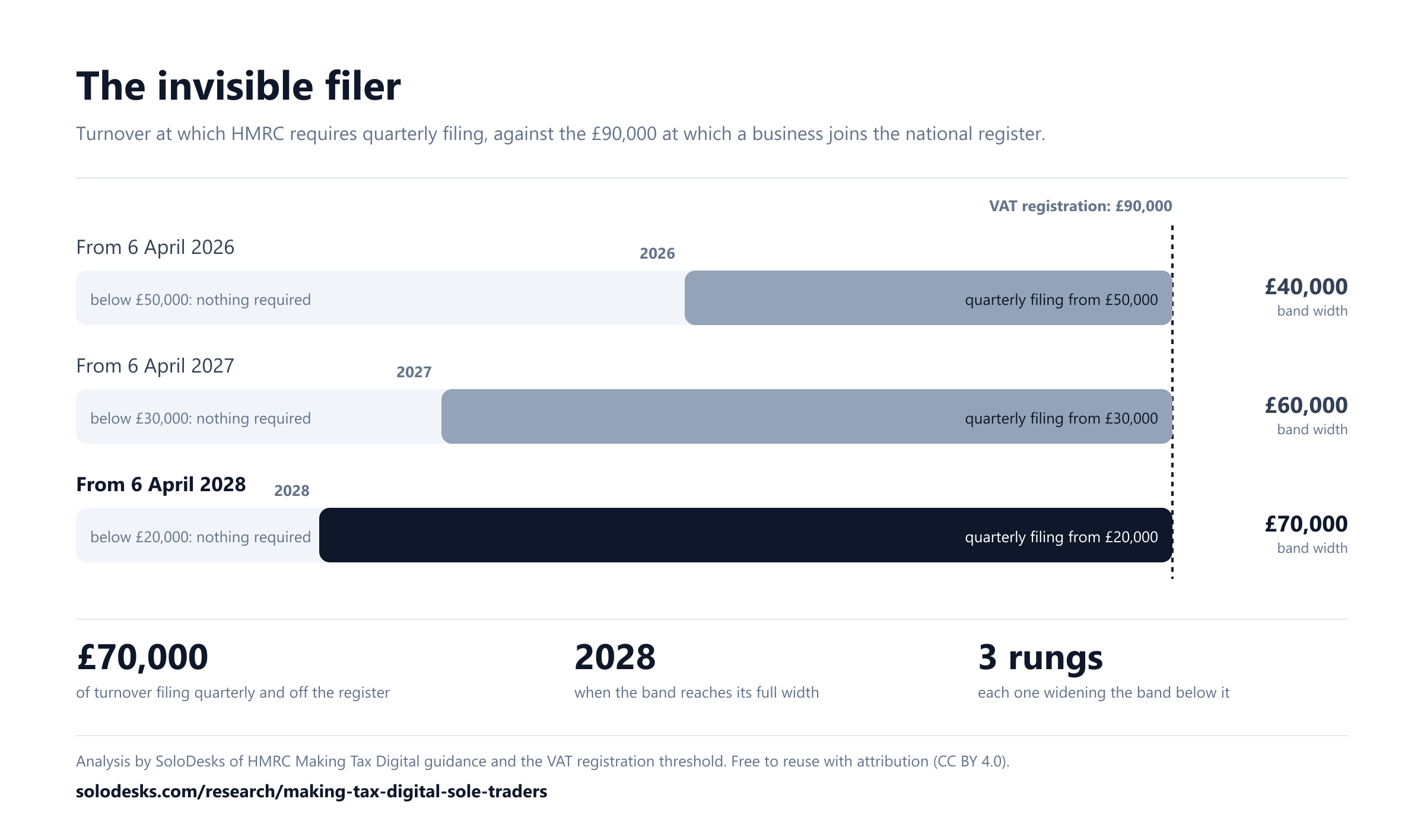
From 6 April 2028, the obligation to keep digital records and file quarterly begins at £20,000 of turnover. Both are turnover tests, so they can be read against each other directly. Between the two sits a band £70,000 wide.
Turnover from £50,000 to £90,000: filing to HMRC every quarter, absent from the business register. Tested on the 2024 to 2025 tax year.
Turnover from £30,000 to £90,000: filing to HMRC every quarter, absent from the business register. Tested on the 2025 to 2026 tax year.
Turnover from £20,000 to £90,000: filing to HMRC every quarter, absent from the business register. Tested on the 2026 to 2027 tax year.
Horizontal scale is annual turnover, £0 to £110k.
Sources: HMRC guidance on Making Tax Digital for Income Tax thresholds and start dates, and the VAT registration threshold. Both ends of every band are turnover tests, so they are directly comparable. No count of the businesses inside the band is shown because none is derivable from published data, which is set out in the limitations below.
The band
£20,000 to £90,000
Turnover at which a business must report to HMRC every three months, and at which no official count of UK businesses records that it exists. We call this the invisible filer.
Our earlier analysis of the same problem found that the Department for Business and Trade estimates 885,485 construction businesses in the UK, while the ONS register records 385,000. The difference, around 500,000 businesses or 57% of the industry, is made up of precisely the businesses this band describes: below the VAT line, employing nobody, invisible to the register.
Not all of them will be over £20,000. Some will be, and no published source says how many. That is the next section.
Read the register gap analysis for the method behind that figure.
The number nobody has
The obvious question is how many businesses each rung of the ladder pulls in. We went looking for it and it does not exist, in any published form, from any of the bodies that would be expected to hold it.
Business Population Estimates break the UK business population down by employee count, legal form, industry and region. They publish no turnover bands. The ONS business register bulletin counts only businesses already registered for VAT or PAYE, so it excludes the group in question by construction. There is no third source that crosses turnover with industry for the unregistered population, because the unregistered population is modelled rather than observed.
So the honest statement is this. The UK is about to require quarterly digital tax reporting from a population whose size it does not measure. We are not able to put a number on it either, and we are saying so rather than estimating one, because an estimate here would be a guess wearing a citation.
What it means for a business of one
Reported as a sector story, this is an administrative change with a long lead time. Read at the scale of one person, it is different in kind rather than degree.
A firm with an office absorbs quarterly reporting into a job somebody already does. A business of one has no such person. The work lands on the same evening that already holds the quoting, the invoicing and the chasing, and it lands four times a year instead of once. The threshold that decides whether that happens is a turnover figure, so it can catch a business whose actual earnings are modest and whose materials bill is large.
There is also a second-order effect worth naming. Because the test adds property income to trade income before expenses, a sole trader turning over £18,000 on the tools with a let flat alongside it can be over the line on the strength of the two together, while neither alone would reach it.
Quarterly filing does not move when the tax is due. It does put the figures in front of you four times a year instead of once, which turns what to set aside from each payment into a running question rather than a January one.
Limitations
Nobody can say how many businesses each rung catches
The obvious next number is how many one-person trade businesses sit in each band, and no published source can give it: neither of the two datasets that would hold it records turnover for unregistered businesses, which is set out in full above. So the size of the affected group is unknown. Treat any figure quoted for it, here or anywhere else, as an estimate until someone publishes the turnover breakdown.
Qualifying income is not only trade income
The threshold test adds together income from self-employment and from property before expenses, so a business can be pulled over the line by a let property rather than by its trade, as the worked example above shows. Anyone sizing this population from trade turnover alone will therefore undercount it, and by how much cannot be derived from the sources here.
The register misses people for two reasons, not one
A business appears on the Inter-Departmental Business Register if it is registered for VAT or for PAYE. This analysis treats the VAT registration threshold as the practical line because a business of one has no employees to put it on PAYE, but a sub-threshold business that voluntarily registers for VAT, or that takes on one member of staff, is on the register regardless of turnover. The band described here is where invisibility is likely, not guaranteed.
Thresholds and dates can change, and have before
Making Tax Digital for Income Tax has been delayed more than once since it was first announced. The three dates on this page are the ones in force and published by HMRC on the date at the top. They are law as it stands, not a forecast, and this page will be re-checked at each rung rather than left to age.
Sources
- Find out if and when you need to use Making Tax Digital for Income Tax
HM Revenue & Customs. Published 23 September 2021, last updated 26 March 2026. Covers which sole traders and landlords must use Making Tax Digital for Income Tax, and from when. - Work out your qualifying income for Making Tax Digital for Income Tax
HM Revenue & Customs. Published 16 October 2024, last updated 16 July 2026. Covers what counts towards the qualifying income test, and what does not. - Business population estimates for the UK and regions 2025
Department for Business and Trade. 2 October 2025. Covers the UK private sector business population at the start of 2025. - UK business: activity, size and location: 2025
Office for National Statistics. 24 September 2025. Covers businesses registered for VAT and/or PAYE, as recorded on the Inter-Departmental Business Register in March 2025.
The statistical releases are published under the Open Government Licence v3.0. The HMRC guidance pages are Crown copyright. Both thresholds and both publication dates were read on the GOV.UK pages themselves on 19 August 2026, not taken from a summary.
Take these figures
Every rung, the tax year it is tested on and the resulting band width, as a CSV. The chart as a PNG or an SVG. No form, no email address, and no permission needed beyond the link below.
In a sentence
For a caption or a line of body copy.
Analysis by SoloDesks of HMRC Making Tax Digital for Income Tax guidance, Department for Business and Trade Business Population Estimates 2025 and ONS UK business: activity, size and location 2025. https://solodesks.com/research/making-tax-digital-sole-traders
As HTML
Paste straight into a post. Includes the link the licence asks for.
<p>Source: <a href="https://solodesks.com/research/making-tax-digital-sole-traders">Analysis by SoloDesks of HMRC Making Tax Digital for Income Tax guidance, Department for Business and Trade Business Population Estimates 2025 and ONS UK business: activity, size and location 2025.</a></p>
As an embedded chart
The whole finding as one picture, credited in the markup.
<figure>
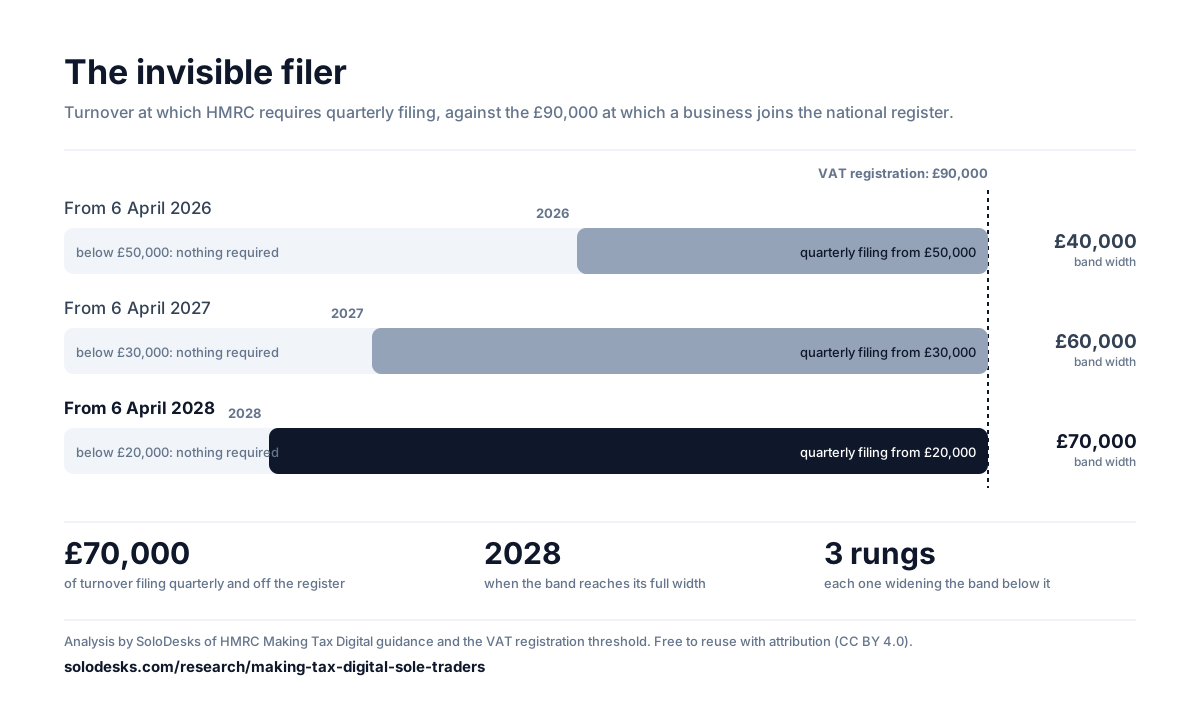
  <img src="https://solodesks.com/research/invisible-filer.png" alt="The invisible filer. Turnover at which HMRC requires quarterly filing under Making Tax Digital for Income Tax, against the £90,000 VAT registration threshold at which a business joins the national business register. The band between the two opens in 2026 and widens at every step down, reaching £70,000 in 2028." width="1200" />
  <figcaption>Source: <a href="https://solodesks.com/research/making-tax-digital-sole-traders">Analysis by SoloDesks of HMRC Making Tax Digital for Income Tax guidance, Department for Business and Trade Business Population Estimates 2025 and ONS UK business: activity, size and location 2025.</a></figcaption>
</figure>
Or take the file: PNG (2400px wide) · SVG (scales to any size). Both carry the source line and the link.


As a reference
For a report, a footnote or a reference list.
SoloDesks (2026) By 2028 the UK will require quarterly tax reporting from half a million businesses it cannot count. Available at: https://solodesks.com/research/making-tax-digital-sole-traders
Questions
- What is Making Tax Digital for Income Tax?
- It is a change to how self-employed people and landlords report income to HMRC. Instead of one Self Assessment return a year, those in scope must keep digital records and send HMRC a quarterly update from compatible software, followed by a final declaration after the tax year ends. It applies to sole traders and landlords registered for Self Assessment.
- When does Making Tax Digital for Income Tax start for sole traders?
- It arrives in three steps, keyed to qualifying income. Over £50,000 from 6 April 2026, over £30,000 from 6 April 2027, and over £20,000 from 6 April 2028. Each step is tested against the return already submitted for an earlier tax year, so the year that puts a person in scope has usually already finished by the time they find out.
- Is qualifying income the same as profit?
- No, and this is the part that catches people out. HMRC defines qualifying income as total income from self-employment and property before expenses, which is turnover. A sole trader with £30,000 of turnover and £12,000 of costs has £18,000 of profit and £30,000 of qualifying income. The threshold test uses the larger figure.
- Can a business be below the VAT threshold and still have to file quarterly?
- Yes, and from 6 April 2028 that describes a wide band. VAT registration is compulsory above £90,000 of taxable turnover. Making Tax Digital for Income Tax reaches down to £20,000 of qualifying income. The £70,000 between them is turnover at which a business must report to HMRC every quarter while remaining below the line that would put it on the national business register.
- How many trade businesses will the £20,000 threshold affect?
- Nobody can say, and any figure presented as an answer is a guess. Business Population Estimates publish no turnover bands, and the ONS business register only counts businesses already registered for VAT or PAYE, which excludes the ones in question by definition. The size of the affected group is genuinely unknown, which is itself the finding on this page.
- Does SoloDesks do Making Tax Digital?
- No. SoloDesks is quoting, invoicing and job scheduling software. It is not on HMRC's list of software compatible with Making Tax Digital for Income Tax, it does not file anything to HMRC, and it is not a substitute for an accountant or for bookkeeping software. This page is analysis of a policy, not a product pitch.
Disclosure: SoloDesks makes quoting and invoicing software for solo tradespeople, so we have an interest in this subject. We do not make Making Tax Digital software and we are not affected commercially by which threshold applies to whom. Free to reuse with a link, under CC BY 4.0. How we source and date every number is set out in our editorial and sourcing policy.