Last checked 31 July 2026
Half a million UK trade businesses are missing from the official business register
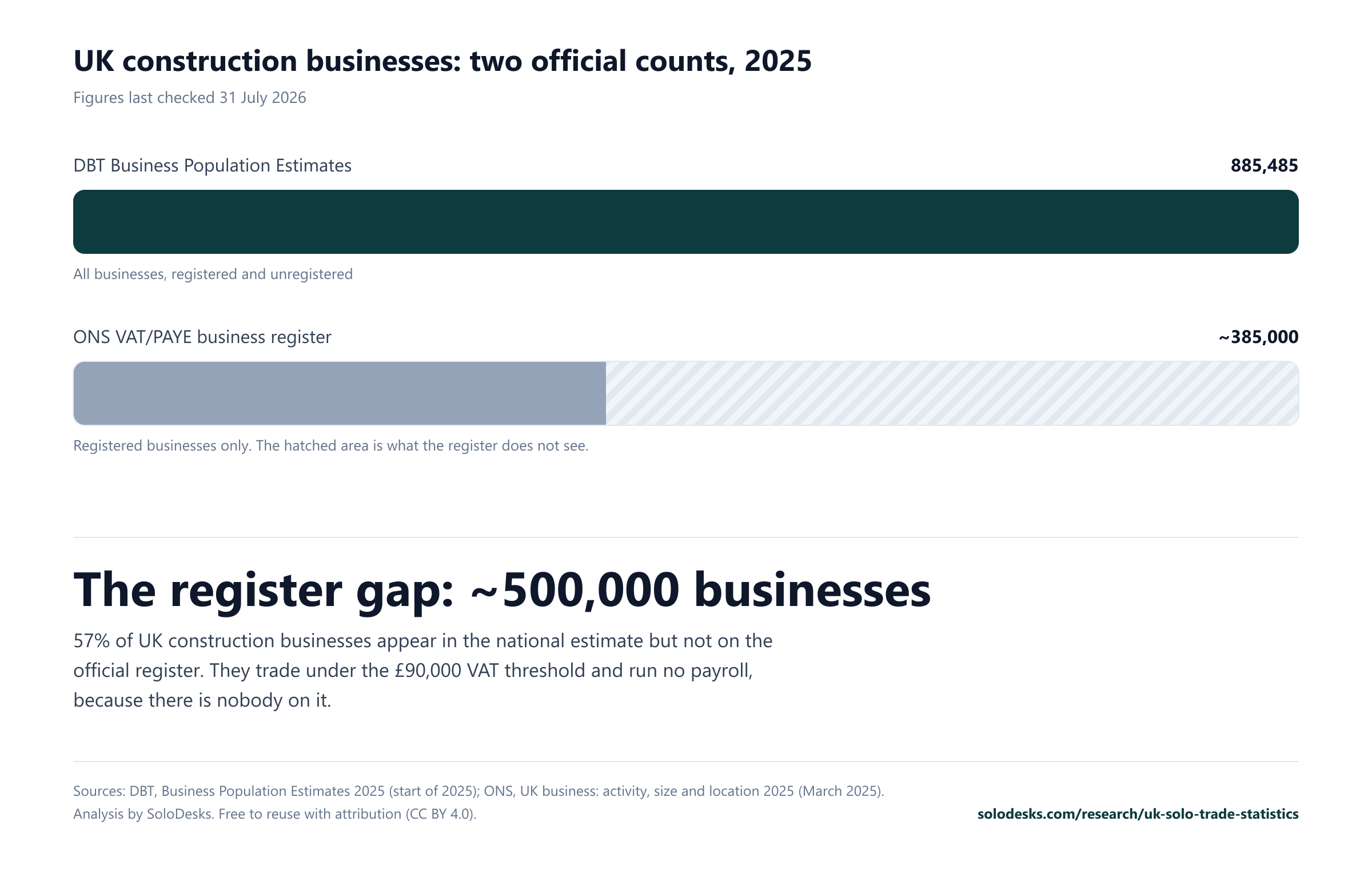
Britain counts its construction businesses twice. The Department for Business and Trade puts the figure at 885,485 at the start of 2025, more than any other single industry. The Office for National Statistics, counting only businesses registered for VAT or PAYE, finds about 385,000. The difference is about 500,000 construction businesses (57% of the industry) that exist in the national estimate but not on the official register. Call it the register gap. It is, overwhelmingly, one person with a van, no employees, and a turnover below the VAT threshold.
Contents
Key findings
- ~500,000
- The register gap: construction businesses the national estimate counts and the VAT/PAYE register does not, which is 57% of the sector.
- 75%
- of all 5,690,265 UK private sector businesses employ nobody at all. That is 4,272,535 of them. The one-person business is not a niche; it is the default shape of a British business.
- £2,200–£3,300
- our estimate of the billable work a solo tradesperson loses each year to chasing late payment, derived from the official 86-hour figure. Method below.
Two counts of the same industry
The two figures are not in conflict. They are measuring different things, and both publishers say so plainly. The ONS bulletin draws on the Inter-Departmental Business Register, which lists businesses registered for VAT and/or PAYE, and notes that DBT publishes the estimate covering everything else. DBT's Business Population Estimates add a modelled figure for the unregistered population, built largely from Labour Force Survey self-employment data.
What nobody publishes is the subtraction. Doing it gives a reasonable estimate of how many construction businesses in Britain are trading below both registration thresholds at once: under the £90,000 VAT threshold, and with no payroll because there is nobody on it.
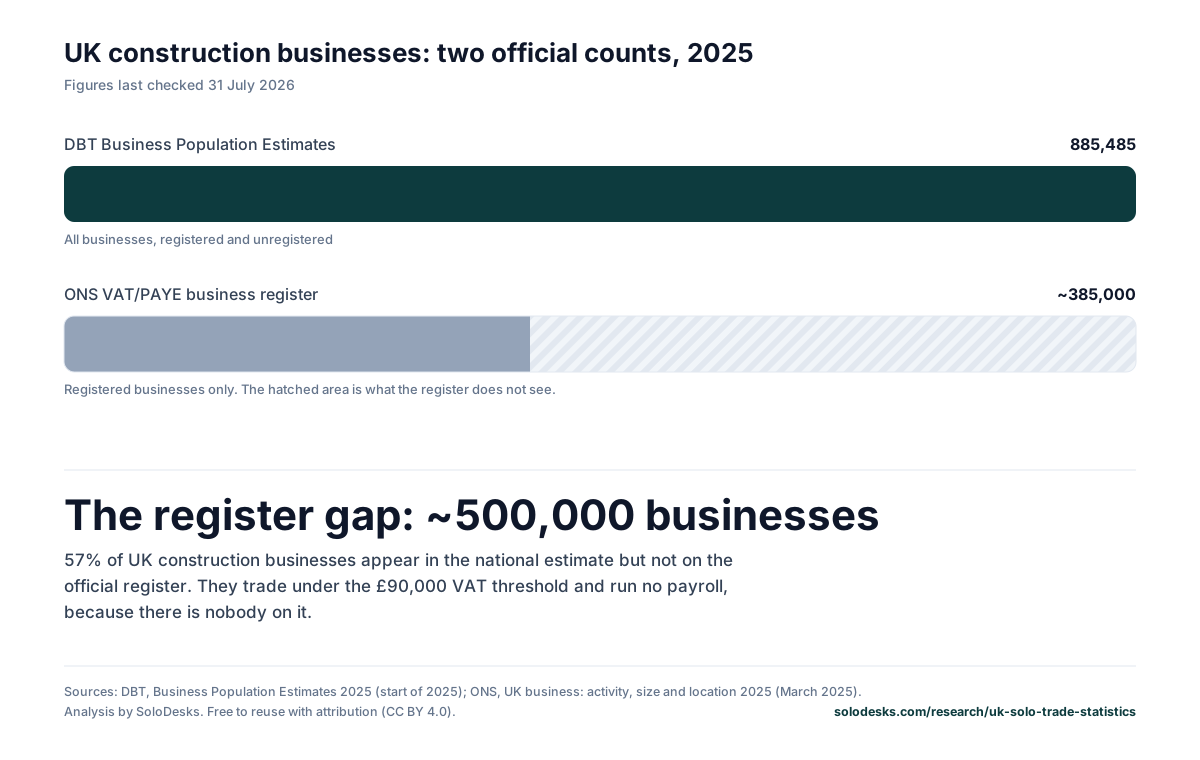
All businesses, registered and unregistered
Registered businesses only. The hatched area is what the register does not see.
~500,000 businesses
The register gap. 57% of UK construction businesses appear in the national estimate but not on the official register. They trade under the £90,000 VAT threshold and run no payroll, because there is nobody on it.
Sources: DBT, Business Population Estimates 2025 (start of 2025); ONS, UK business: activity, size and location 2025 (March 2025). Analysis by SoloDesks. Free to reuse with attribution (CC BY 4.0).
Take this chart: PNG · SVG. Free to reuse with a link, and there is a ready-made embed snippet below.
| Source | Coverage | Construction businesses |
|---|---|---|
| DBT, Business Population Estimates 2025 | All businesses, registered and unregistered (start of 2025) | 885,485 |
| ONS, UK business: activity, size and location 2025 | Registered for VAT and/or PAYE only (March 2025) | ~385,000 |
| Difference | Trading below both registration thresholds | ~500,000 |
The subtraction gives 500,485, but the register figure is published rounded, so the gap is quoted to the nearest 10,000 throughout. A difference is never more precise than the least precise number in it.
The national picture says the same thing in a different way. 4,272,535 of the UK's 5,690,265 private sector businesses employ nobody, 75% of them. Of 3.2 million sole proprietorships, 3.0 million have no employees beyond the owner. Construction is simply where that pattern is most concentrated, and it is the largest business population of any industry in the country.
What late payment costs a business of one
The scale of the problem is not ours to establish. Research by London Economics for DBT and the Office of the Small Business Commissioner, published in July 2025, put it like this.
- UK businesses affected each year
- over 1.5 million (28%)
- Owed to them at any one time
- £26 billion
- Average owed per business
- £17,000
- Cost to the economy, a year
- almost £11 billion
- Businesses closing because of it
- 14,000 a year, 38 a day
- Time spent chasing, per affected business
- 86 hours a year
The last row is the one that changes meaning with company size.The hours are an average across every business affected by late payment, not only the 22% who said they spend staff time chasing at all, and they add up to 133 million hours across the economy.
For a firm with an office, those hours are an overhead absorbed by somebody whose job it is. For a business of one there is nobody to absorb them. Every hour chasing an invoice is an hour not on the tools, which makes it lost billable capacity rather than an overhead. It should be priced like one.
How we get to £2,200–£3,300
- Start with the official figure: 86 hours a year chasing late payment, per affected business (DBT/OSBC, July 2025).
- Divide by an 8-hour working day: 86 ÷ 8 ≈ 11 working days.
- Multiply by a typical UK trade day rate of £200–300, the same band published on our day rate calculator: £2,200–£3,300.
This is an illustrative cost of lost capacity, not a measured loss. It assumes the chasing hours would otherwise have been billable, which for a sole trader with a full order book is roughly true and for one without work is not. The day-rate band is itself aggregated from third-party UK trade cost guides, not official statistics.
Limitations
The objections a statistician would raise, answered before they are asked.
The two counts are three months apart
Business Population Estimates describe the population at the start of 2025; the ONS register figure is from March 2025. Three months of business formation and closure sit inside the gap. It is nowhere near large enough to explain half a million businesses, but the comparison is not a same-day one and should not be presented as one.
One is a register, the other is an estimate
The ONS figure is an administrative count of businesses registered for VAT or PAYE. The DBT figure adds a modelled estimate of the unregistered population, built largely from Labour Force Survey self-employment data. Modelled numbers carry uncertainty that a register does not. The gap is therefore an estimate of a gap, not a headcount.
This is a deliberate like-for-unlike comparison
Subtracting a register from an estimate would be a mistake if the point were to measure the industry. The point is the opposite: to measure what the register misses. DBT and ONS both say plainly that their coverage differs. This analysis takes them at their word and puts a number on the difference.
“Construction” leaves real trades out
Both sources use SIC Section F, which covers building work but not everything a person would call a trade. Domestic cleaning and much of landscaping sit under other SIC sections entirely. The true number of one-person trade businesses in the UK is therefore larger than the figure here, not smaller.
Sources
Figures last checked 31 July 2026. Next update October 2026, when the next Business Population Estimates are published.
- Business population estimates for the UK and regions 2025
Department for Business and Trade
Published 2 October 2025 · Covers the UK private sector business population at the start of 2025
- UK business: activity, size and location: 2025
Office for National Statistics
Published 24 September 2025 · Covers businesses registered for VAT and/or PAYE, as recorded on the Inter-Departmental Business Register in March 2025
- Late Payments Research: estimating the total economic impact
London Economics, for the Department for Business and Trade and the Office of the Small Business Commissioner
Published 31 July 2025 · Covers UK businesses affected by late payment
Use these figures
This analysis is free to reproduce, in whole or in part, including commercially, under a CC BY 4.0 licence. The one condition is attribution with a link.
Every figure above is in one spreadsheet, with its source, the period it covers and the arithmetic behind the derived ones: download the data (CSV). Anything it does not answer, email support@solodesks.com.
In a sentence
For a caption or a line of body copy.
Analysis by SoloDesks of DBT Business Population Estimates 2025 and ONS UK business: activity, size and location 2025. https://solodesks.com/research/uk-solo-trade-statistics
As HTML
Paste straight into a post. Includes the link the licence asks for.
<p>Source: <a href="https://solodesks.com/research/uk-solo-trade-statistics">Analysis by SoloDesks of DBT Business Population Estimates 2025 and ONS UK business: activity, size and location 2025.</a></p>
As an embedded chart
The whole finding as one picture, credited in the markup.
<figure>
  <img src="https://solodesks.com/research/register-gap.png" alt="The register gap. UK construction businesses in 2025: the DBT estimate against the smaller ONS VAT/PAYE register, and the gap between them" width="1200" />
  <figcaption>Source: <a href="https://solodesks.com/research/uk-solo-trade-statistics">Analysis by SoloDesks of DBT Business Population Estimates 2025 and ONS UK business: activity, size and location 2025.</a></figcaption>
</figure>
Or take the file: PNG (2400px wide) · SVG (scales to any size). Both carry the source line and the link.


As a reference
For a report, a footnote or a reference list.
SoloDesks (2026) Half a million UK trade businesses are missing from the official business register. Available at: https://solodesks.com/research/uk-solo-trade-statistics
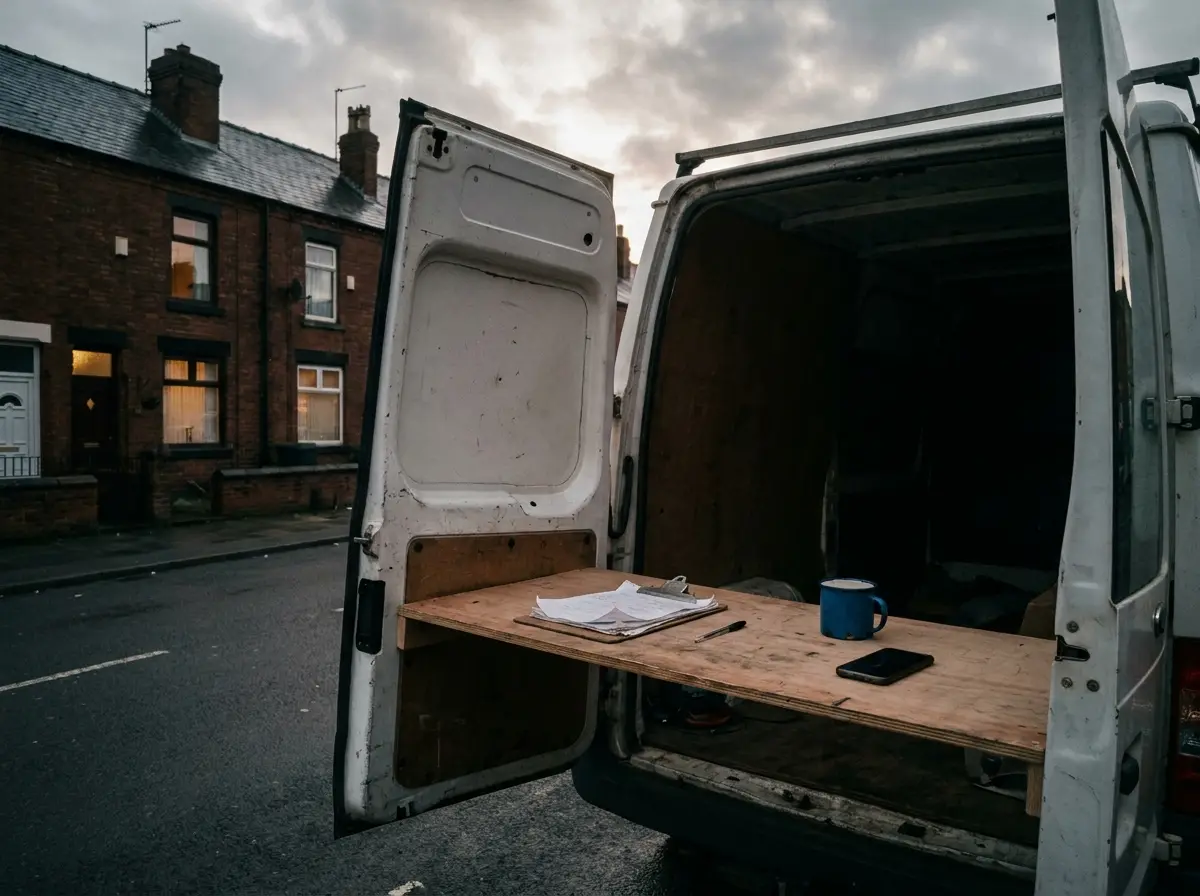
The underlying government data is published under the Open Government Licence v3.0. The licence above covers the analysis, the figures and the chart. It does not cover the photograph, which is illustrative and not ours to license.
Questions
- How many construction businesses are there in the UK?
- 885,485 at the start of 2025, according to the Department for Business and Trade's Business Population Estimates. That is the largest number of any single industry. Only around 385,000 of them were registered for VAT or PAYE on the ONS business register in March 2025.
- How many UK tradespeople are self-employed with no employees?
- Across the whole economy, 4,272,535 of the UK's 5,690,265 private sector businesses employ nobody, which is 75%. In construction specifically, the gap between the full-coverage estimate and the VAT/PAYE register suggests roughly 500,000 construction businesses operate below the registration thresholds, which in practice means one person with no employees turning over less than £90,000.
- Why do the two official figures disagree?
- They are counting different things on purpose. The ONS figure comes from the Inter-Departmental Business Register, which lists businesses registered for VAT and/or PAYE. The DBT estimate adds a modelled figure for the unregistered population, drawn largely from Labour Force Survey self-employment data. Neither is wrong; the difference between them is a measure of how much of the economy sits below the registration thresholds.
- What does late payment cost a one-person trade business?
- The official research puts the time cost at 86 hours a year chasing payment, per business affected by late payment. Chasing is the most common response to it, reported by 22% of the businesses surveyed. For a business with staff that is an admin overhead. For a sole trader there is nobody else to absorb it, so those 86 hours, about 11 working days, are hours not on the tools. At typical UK trade day rates of £200–300, that is roughly £2,200–£3,300 of billable capacity a year.
Read next: the invisible filer, which takes the gap on this page and asks what happens when quarterly tax reporting reaches businesses the register cannot see.
Or the retention floor, our analysis of the first construction retention disclosures and how many large firms hold money back from a job of any size.
Built for the 57%
The businesses in that gap sit below both registration thresholds: no VAT, no payroll, one person doing the quoting, the invoicing and the chasing. SoloDesks is built for that shape of business and priced for one, with no per-seat tier to grow into.
Disclosure: SoloDesks makes quoting and invoicing software for one-person businesses, which is the population this analysis counts. That makes us an interested party in how many of them there are, which is why both official figures are named and linked rather than summarised, the derivation is a subtraction anyone can repeat, and the working is published as a file above. The licence for reuse is in Use these figures. How we source and date every number is set out in our editorial and sourcing policy.