Last rebuilt 18 August 2026
Nine in ten large firms holding construction retention set no minimum job size
From this year, large UK companies have to say in public whether they hold retention on the construction work they commission, how much, and whether there is a job small enough to be exempt. Retention is money held back from work already done, as security against defects, and released months later. The first 762 answers are in. 92% of them declare no minimum job size at all. A £4,000 job and a £4m job are treated the same way.
Retention is on its way out, which is the reason to count it now. In its response to the late payment consultation, published 24 March 2026, the government proposed “to take forward a legislative measure to prohibit the deduction and withholding of retention payments under the terms of a construction contract”. It added that “given the ambition of the policy” it will “consult further with interested parties on the impact of this measure before taking a final decision on implementation”.
So the figures below are a baseline rather than a description of a settled practice. Reporting began only for financial years starting on or after 1 April 2025, so this is the first disclosure window and so far the only one. It records what retention looked like while it was still standard, in the period the government is consulting on. This page will keep counting through the transition.
Source: Late payment consultation: time to pay up, government response, Department for Business and Trade.
Contents
What the first filings show
- 1,387 companies reported awarding qualifying construction contracts. 762 of them, 54.9%, hold retention.
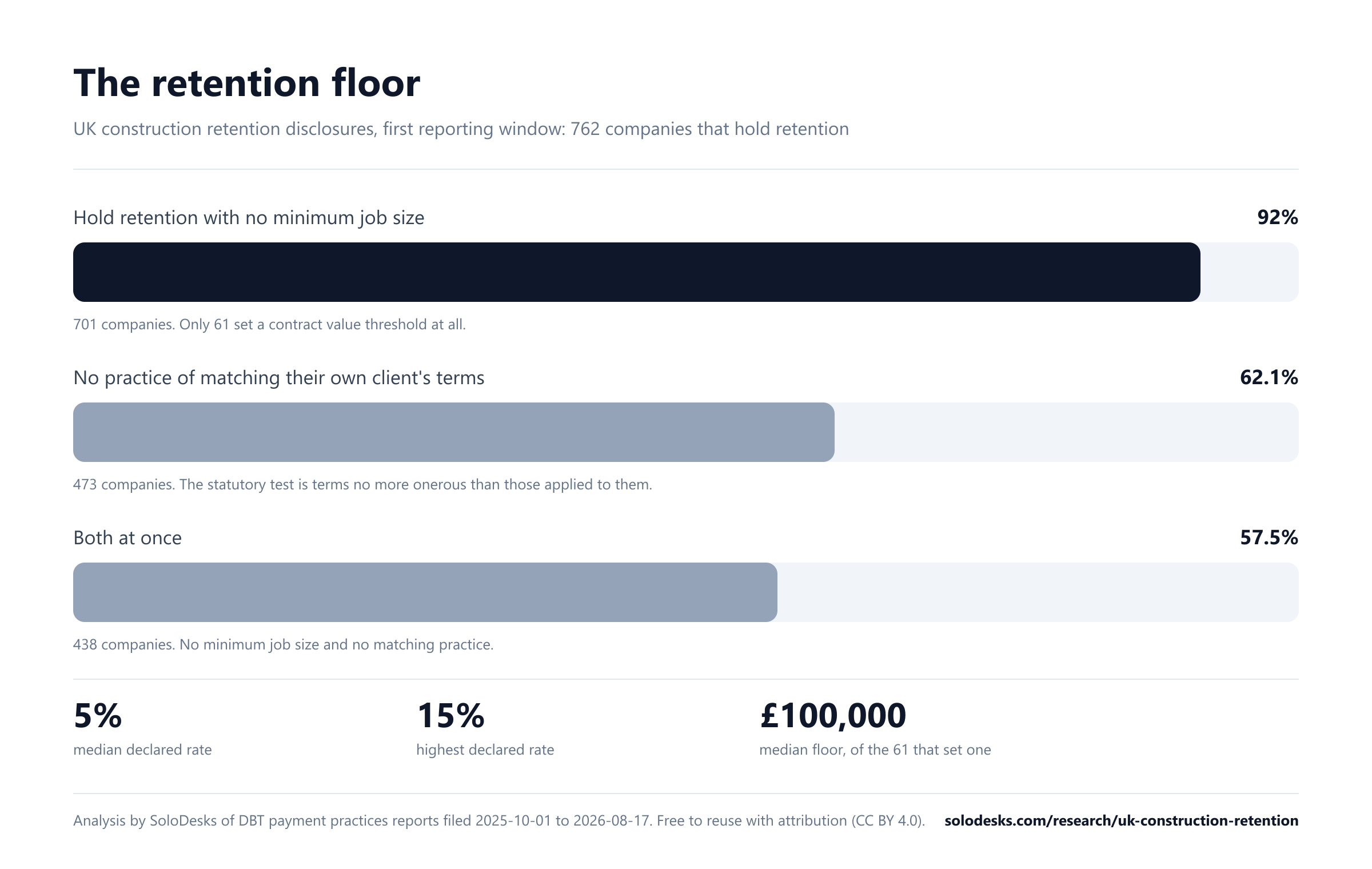
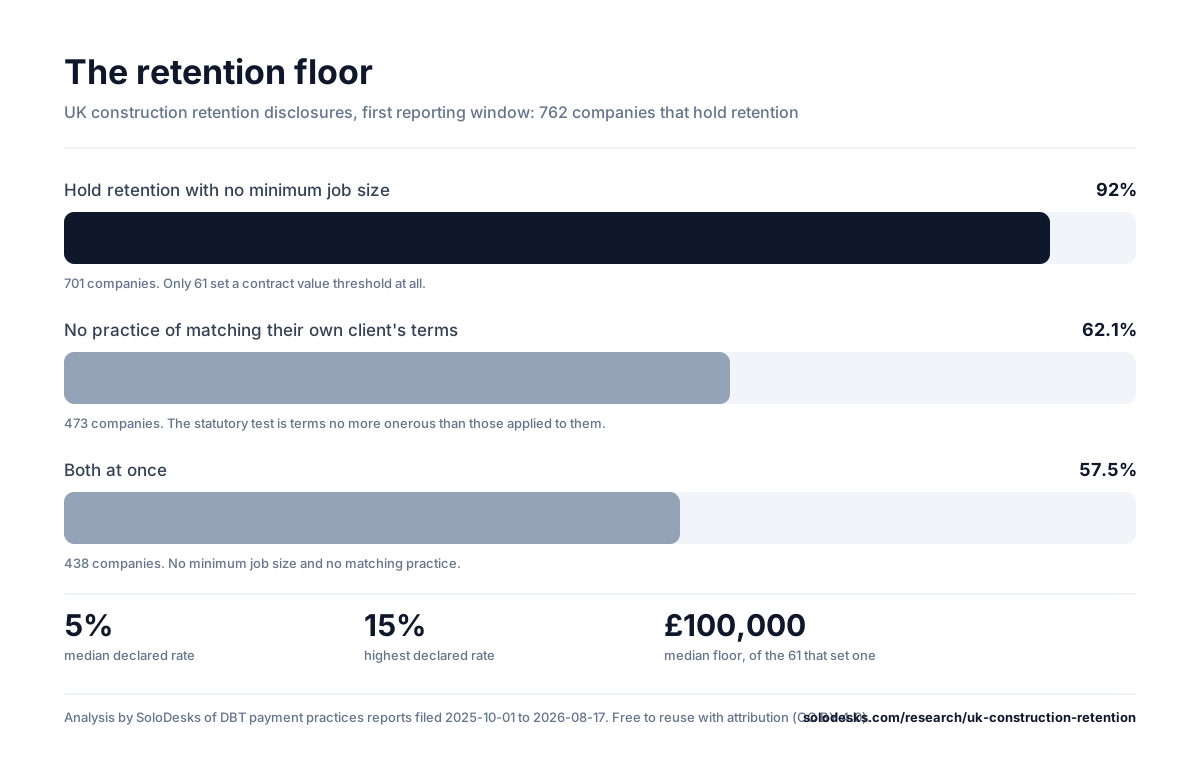
- 92% set no minimum contract value. Only 61 of 762 declared a threshold below which retention is not applied, and among those the median was £100,000.
- 62.1% have no practice of matching their own client's terms. 438 companies, 57.5% of those holding retention, do both: no minimum job size and no matching practice.
- The median declared rate is 5%. On a £4,000 job that is £200 held back after the work is finished and the invoice is paid.
701 of 762 companies. They told the government they operate no contract value below which retention is not applied.
473 of 762 companies. The statutory question asks whether supplier terms are kept no more onerous than the terms applied to them on the same project.
438 of 762 companies. No minimum job size and no matching practice.
Source: SoloDesks analysis of the Department for Business and Trade payment practices export, reports filed 2025-10-01 to 2026-08-17. Latest report per company. Every figure is the company's own filed answer.
The retention floor
Retention is normal and it is old, and on a contract worth millions it is a rounding error carried by a business with a finance department. The question nobody had data on until this year is where it stops. Is there a job small enough that a firm does not bother?
Call that threshold the retention floor. The reports now ask for it directly, and 92% of the companies holding retention answered that they do not have one. Among the 61 that do, the median floor is £100,000, which is far above the value of the work a one-person business takes on.
This matters more the smaller the supplier is, and not proportionally. 5% of a £50m contract is a financing cost. 5% of a £4,000 job is £200, held for months after the work is signed off, by a business that has already paid for the materials and cannot chase it without risking the next job.
Nothing in the reports says what a business that size should do about it. One lever sits on the other side of the ledger, and it is what gets asked for before the work starts rather than after it is signed off: a deposit question.
What the companies were actually asked
Every figure here is a restatement of a company's own answer to a statutory question. The wording matters, because the distance between the question and a headline is where this kind of analysis usually goes wrong. The questions are these.
- Minimum contract value
- “Whether retention clauses are only used in qualifying construction contracts with suppliers above a specific contract sum.”
- Parity with their own client
- “Whether there is a practice of ensuring that the terms of any retention clauses with suppliers in qualifying construction contracts are no more onerous than the terms of the retention clauses applied to the business on the same project by their client.”
- Standard rate
- “Whether a standard percentage rate is used in retention clauses.”
- Release
- “The standard mechanism for the release of retentions, and whether the money is released in stages.”
So a company reported here as having no minimum job size has told the government it operates no such rule. That is not the same as evidence it has held retention on a small job, and it is not quoted here as if it were.
The measure everyone watches says construction is fine
Payment performance in construction has been benchmarked for years on one number: how long a firm takes to pay an invoice. By that number the sector is in decent shape. Among companies reporting construction contracts the median average time to pay is 31 days, against 32 days for every other reporting company in the country. The median share of invoices paid later than agreed is 14% against 18%.
Both of those are better than the rest of the economy. That is a real improvement and it deserves saying plainly, because the obvious version of this article would have buried it.
What it also means is that the invoice arriving on time is no longer the whole picture. A payment can be made in full, on schedule, with 5% of it never included in the first place. Retention does not appear in a days-to-pay figure at all, and until March 2025 nobody had to disclose it. The pressure moved to the part that was not being counted.
Method
The Department for Business and Trade publishes every payment practices report as a single export. This analysis takes that file, keeps the reports that answer yes to having qualifying construction contracts in the period, and reduces them to the latest report per company number, so a firm that files twice a year is counted once.
That leaves 1,387 companies, of which 762 disclose holding retention. The retention questions were added by the The Reporting on Payment Practices and Performance (Amendment) (No. 2) Regulations 2024, in force 1 March 2025 and applying to financial years beginning on or after 1 April 2025, so every report carrying them is a first filing. Reports in this snapshot were filed between 2025-10-01 and 2026-08-17.
Every average given is a median. The full export contains obvious filing errors, and they are large enough to matter: the mean average time to pay across non-construction reporters comes out at 597 days, because some filers have typed a date into a field that wants a number of days. A median survives that. A mean does not, and quoting one would have been the fastest way to have the whole analysis dismissed.
The script that produces these figures is scripts/build-retention.mjs. Point it at a fresh copy of the export and it reproduces every number on this page, including the ones in the chart.
Take the data
Both files are published alongside the analysis, because a finding nobody can check is a claim. The first is every company in the dataset with its own filed answers. The second is the summary, with the denominator beside each figure so the arithmetic is visible.
What this analysis cannot tell you
Only companies above the statutory size threshold have to file at all, so every figure here describes large firms. The small and mid-size firms that also award subcontracts are not in the data, and nothing in this analysis should be read across to them.
This is the first window, so there is no trend
Every report in this dataset is a first filing, because the duty is new. That makes these figures a baseline and nothing more: they cannot yet show whether practice is improving or worsening, and any page claiming they do is reading something into them that is not there. The comparison to make is against the next window, not against anything published before this one.
The figures are self-reported and unaudited
Companies answer these questions about themselves and nobody checks them. Obvious filing errors survive into the published export, which is why every average on this page is a median rather than a mean; the method section shows what that guards against. A wrong answer here is a wrong answer in the government's own dataset, and it is reproduced faithfully.
These are not all construction companies
The duty applies to any large company that awards qualifying construction contracts, whatever it does for a living. Supermarkets, utilities, charities and manufacturers appear alongside contractors and housebuilders, because they all commission building work. That is the right population for this question, since it is the population a subcontractor invoices, but it means these are the firms that hire construction, not the construction industry.
No declared floor is not the same as proof of a £1 floor
The question asks whether retention is used only above a specific contract sum, so a company answering no has declared the absence of a policy, not the presence of a practice. Read every figure on this page that way. If anything the count understates the caution in the market, because a firm can decline small jobs for reasons it never has to file.
Parity is a question about practice, not about outcomes
The parity question asks whether a business has a practice of ensuring its retention terms with suppliers are no more onerous than those its own client applies to it on the same project. Answering no means no such practice is in place. It does not prove any individual subcontractor was treated worse, and the honest reading is an absence of a safeguard rather than evidence of harm.
Only about half declare a standard rate
395 of the 762 companies holding retention declare a standard percentage. The rest report that the rate varies by contract, so the median rate here describes the companies with a fixed policy, not the whole population.
Sources
- Payment practices and performance reports, full export
Department for Business and Trade. Updated continuously as reports are filed. Covers every payment practices report filed since the duty began in 2017, including the retention fields introduced for construction contracts in 2025. - The Reporting on Payment Practices and Performance (Amendment) (No. 2) Regulations 2024
UK Parliament. In force 1 March 2025. Covers financial years beginning on or after 1 April 2025, for qualifying construction contracts. - Duty to report: guidance on reporting on payment practices and performance
Department for Business and Trade. Updated 2025. Covers the wording of every question a reporting business must answer, including the retention questions. - Late payment consultation: time to pay up, government response
Department for Business and Trade. 24 March 2026. Covers the government's decision to legislate against retention, and the further consultation still to come on implementation.
The underlying government data is published under the Open Government Licence v3.0. Company names appear as filed. Every company-level statement on this page and in the CSV is that company's own disclosure, not our characterisation of it.
In a sentence
For a caption or a line of body copy.
Analysis by SoloDesks of the Department for Business and Trade payment practices and performance reports, retention disclosures filed 2025-10-01 to 2026-08-17. https://solodesks.com/research/uk-construction-retention
As HTML
Paste straight into a post. Includes the link the licence asks for.
<p>Source: <a href="https://solodesks.com/research/uk-construction-retention">Analysis by SoloDesks of the Department for Business and Trade payment practices and performance reports, retention disclosures filed 2025-10-01 to 2026-08-17.</a></p>
As an embedded chart
The whole finding as one picture, credited in the markup.
<figure>
  <img src="https://solodesks.com/research/retention-floor.png" alt="The retention floor. 92% of large UK companies holding retention on construction contracts declare no minimum job size, and 62.1% have no practice of matching their own client's retention terms" width="1200" />
  <figcaption>Source: <a href="https://solodesks.com/research/uk-construction-retention">Analysis by SoloDesks of the Department for Business and Trade payment practices and performance reports, retention disclosures filed 2025-10-01 to 2026-08-17.</a></figcaption>
</figure>
Or take the file: PNG (2400px wide) · SVG (scales to any size). Both carry the source line and the link.
As a reference
For a report, a footnote or a reference list.
SoloDesks (2026) Nine in ten large firms holding construction retention set no minimum job size. Available at: https://solodesks.com/research/uk-construction-retention
Questions
- What is retention in construction?
- Retention is a percentage of each payment that the paying party keeps back rather than paying, as security against defects. It is released later, usually in stages: part when the work is certified complete, the rest after a defects period set by the contract. Until it is released it is money the subcontractor has earned and cannot spend.
- How much retention is normally held on UK construction work?
- Among the 762 large companies that disclosed holding retention on construction contracts in the first reporting window, 395 declared a standard rate. The median was 5%, and 250 of them used exactly 5%. 10 declared a rate above 5%, the highest being 15%. The rest report that the rate varies by contract.
- Is there a minimum job size below which retention is not held?
- Usually not. 701 of the 762 companies holding retention, 92%, told the government they apply no contract value threshold. Only 61 declared one at all, and among those the median threshold was £100,000. That is the finding this page calls the retention floor, and for most reporting firms there is not one.
- Do large firms pass their own retention terms down the chain?
- The reports ask whether a business has a practice of ensuring its retention terms with suppliers are no more onerous than the terms its own client applies to it on the same project. 473 of 762 companies, 62.1%, answered no. That means no such safeguard is in place. It is not evidence that any individual subcontractor was treated worse.
- Are construction clients slow payers?
- Not by the measure everyone benchmarks. The median average time to pay among companies reporting construction contracts was 31 days, against 32 days for every other reporting company, and the median share of invoices paid later than agreed was 14% against 18%. On speed, construction now looks slightly better than the rest of the economy. The money that does not arrive on time is not the whole story, because a part of it is retained by agreement instead.
- Where does this data come from?
- Every large UK company and LLP over the statutory size threshold must publish a payment practices report twice a financial year. Since financial years beginning on or after 1 April 2025, those reports must also disclose retention practice on qualifying construction contracts. This analysis is built from the government's full export of those reports, taking the latest report filed by each company.
Related: the register gap, our analysis of how much of the trade sector no official register records, the invisible filer, on what quarterly tax reporting asks of those same businesses, and everything else we publish.
Disclosure: SoloDesks makes quoting and invoicing software for solo tradespeople, who are usually the ones whose money is held back rather than the ones holding it. That gives us an interest in this subject, which is why the per-company data is published above in full, the limitations are printed rather than summarised, and every company-level statement is that company's own filed answer rather than our characterisation of it. Free to reuse with a link, under CC BY 4.0. How we source and date every number is set out in our editorial and sourcing policy.